
Hello from muggy, overcast, and yet still totally hip, Brooklyn!
Our drive up yesterday was smooth sailing and we arrived at my cousin’s gorgeous apartment right on schedule. I am looking forward to a day of walking and sight-seeing and a night full of family celebrating my grandmother.
Last week a reader asked me if I have a Kombucha recipe posted and I realized I don’t. I’ve talked about making Kombucha many times but I haven’t written a step-by-step recipe.
Kombucha, in theory, is very easy to make. In practice I find that every batch varies because the yeast and bacteria is very sensitive to temperature fluctuations, this is to say that every batch is different but most are great.
Here’s how you do it.
You’ll need:
- a large glass jar, at least 2 quarts
- 2 bags or equivalent of loose black tea per quart of finished tea
- 1/4 cup sugar per quart of finished tea
- 8-10 ounces of store-bought Kombucha (like GT‘s, yum!)
STEP ONE
Fill your jar with cold water, leaving about 2 cups worth of head space for the commercial tea you’ll add later, pour water into a large stainless steel pot, boil, turn off, add tea and sugar to pot. Stir to dissolve sugar and leave to steep for 15-20 minutes. Remove tea bags, place a clean kitchen cloth over pot to keep out bugs, and let cool to room temperature (a few hours).
STEP TWO
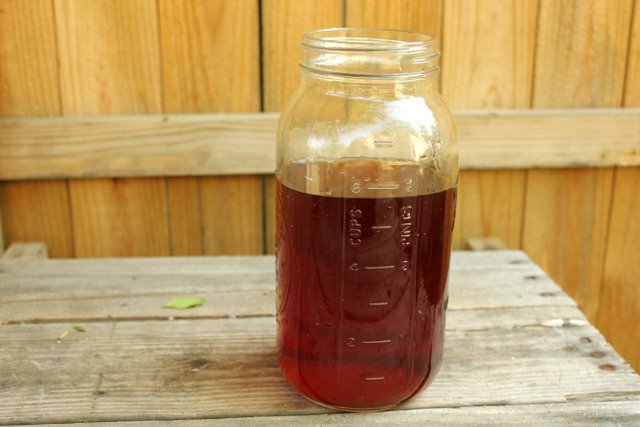
Once tea is cool, pour into your jar.
STEP THREE
Add the Kombucha to the cooled tea.
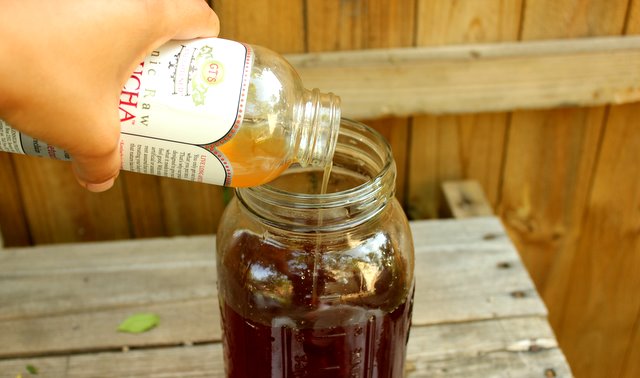
NOTE: Kombucha is made from a culture of bacteria and yeast. This culture is very sensitive to metal. Never stir with or make contact with Kombucha and metal, from this point forth use wood spoons to stir and taste.
STEP FOUR
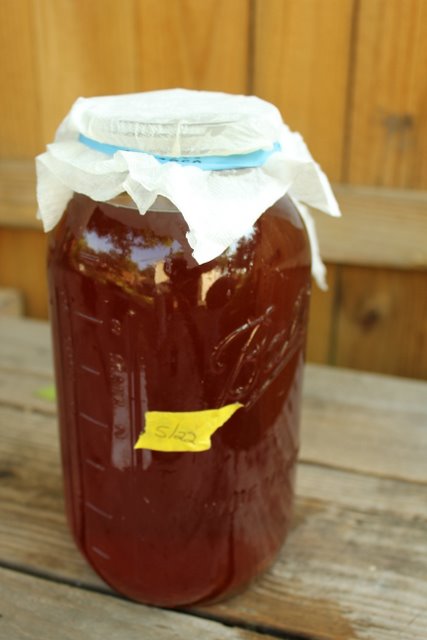
Cover jar with a clean napkin and rubber band and label your jar with the current date.
STEP FIVE
Set jar in a dark, clean, out-of-the-way spot where it can sit undisturbed for 1-2 weeks. I use a section of our dish hutch as my Kombucha closet.
STEP SIX
After one week check on your tea. Peek under the napkin and see what’s developed. You are looking for the formation of a SCOBY (Symbiotic Colony of Bacteria and Yeast) on top of the tea. The SCOBY should be off-white and covering the entire top of the jar.

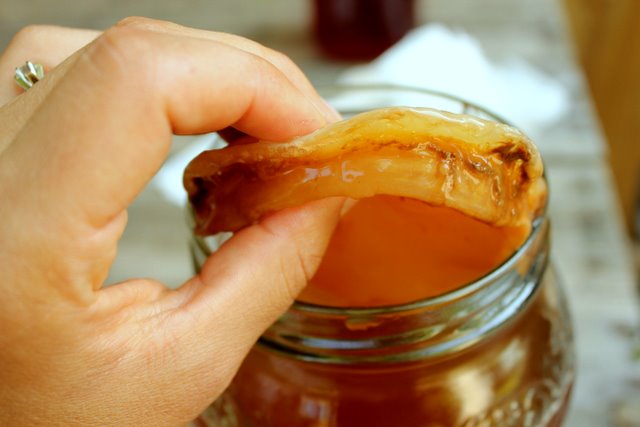
Pour a little tea into a cup and taste it. It should no longer be sugary sweet, there should be a nice tang reminiscent of apple cider vinegar, and maybe a little effervescence. If it still tastes like sweet tea, recover and let sit for another 3-7 days. Retaste every few days until your desired tang is reached.
STEP SEVEN
At this point place the SCOBY into another clean glass jar with enough of your new Kombucha to cover it and set it aside*. Bottle your tea into clean GT bottles or other empty, clean glass or plastic bottles, adding a splash of juice if you like and leaving a good inch or two head room.
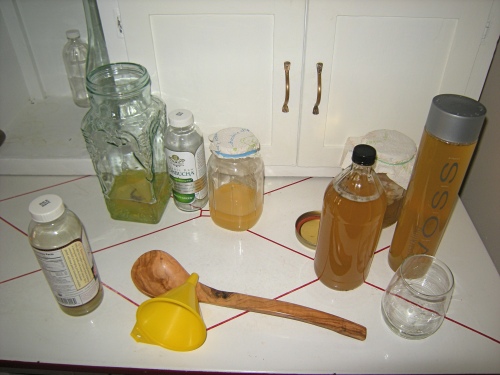
STEP EIGHT
Place bottles into fridge or back into room temperature storage. The Kombucha will continue to ferment and if stored at room temp will get more effervescent. Watch out for too much bubbly build up-check the bottles every 2-3 days and when a nice amount of bubbles and good flavor is reached move to fridge to slow the fermentation.
Drink up!
I drink 8-12 ounces before or after lunch about 5 days a week.
*To make your second batch follow the same procedure EXCEPT for step three use your homemade Kombucha instead of store bought and add the SCOBY to the jar as well.
It may seem a little complicated or time consuming but now that I am familiar with the process it takes me a total of about 10 working minutes to make a batch of Kombucha. I DO NOT, however, recommend attempting to make this if you are not already a Kombucha convert. I admit it, Kombucha is weird stuff and if you aren’t already a big fan who is looking for an alternative to spending $4 a bottle than making it from scratch probably isn’t for you.
Please comment with any questions you still have about Kombucha!


 Gracefulfitness